Nasal Creatine vs Oral Tablets: Why Direct Brain Delivery Could Offer a Cognitive Edge
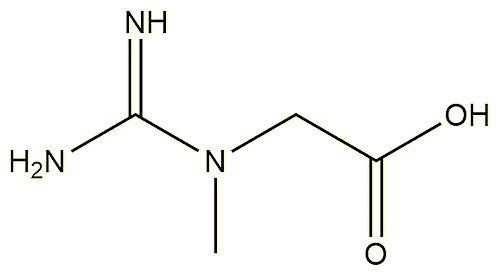
https://www.chm.bris.ac.uk/motm/creatine/creatinejs.htm
Creatine is famous as a muscle supplement. But the brain is an energy-hungry organ too, and creatine sits at the center of how it manages that energy.
Traditional oral supplementation raises skeletal muscle creatine reliably and predictably. Raising brain creatine through the bloodstream is a different story: it is slow, limited and inconsistent.
That limitation has driven interest in intranasal delivery routes that bypass the blood-brain barrier and may offer a faster, more targeted cognitive boost. The human data do not exist yet. But the animal data are striking, and the pharmacokinetic logic is unusually clear.
Why the brain cares about creatine
Creatine and phosphocreatine form a buffering system that regenerates ATP rapidly in tissues with high and fluctuating energy demand, including the brain. The reversible reaction catalyzed by creatine kinase converts phosphocreatine and ADP into creatine and ATP, sustaining ATP levels during intensive neuronal firing more quickly than oxidative phosphorylation alone can.
Higher brain creatine supports tasks that depend on intact mitochondrial function and high energy throughput: working memory, long-term memory formation and complex reasoning. It may also reduce oxidative stress by improving mitochondrial ATP coupling and scavenging reactive oxygen species.
The strongest hint of importance comes from rare genetic disorders. Creatine-deficiency syndromes in humans result in low brain creatine and severe cognitive and developmental impairments. When creatine levels are restored, some of those impairments partially reverse. The compound matters for normal cognition.
What oral creatine actually does for cognition
Multiple systematic reviews and meta-analyses report that oral creatine supplementation improves memory performance in healthy individuals, with standardized mean differences around 0.3. Benefits also appear for information processing speed and attention. Effects are most robust in older adults and under conditions of metabolic stress, while global cognition and executive functions show more variable results and may not improve in young, well-rested subjects at all. (Roschel et al., 2021; Forbes et al., meta-analysis)
Creatine appears particularly effective when the brain is stressed by hypoxia, sleep deprivation or disease. Supplementation can offset hypoxia-induced cognitive decrements and improve performance in prolonged mental tasks that normally induce fatigue.
A 2024 study pushed this further with a single high oral dose given during sleep deprivation. Creatine acutely reduced fatigue, improved short-term memory and reaction speed, and measurably changed cerebral high-energy phosphate ratios within hours, with effects peaking around four hours after ingestion. This contradicted the earlier belief that cognitive benefits only appear after long-term loading. (Gordji-Nejad et al., 2024)
The problem: getting creatine into the brain
Creatine has low water solubility and limited passive membrane diffusion. Its uptake from the bloodstream into the central nervous system depends on the creatine transporter SLC6A8, located on the endothelial cells of the blood-brain barrier.
That transporter operates near saturation and is absent from astrocytic layers of the barrier. Additional creatine in the blood therefore produces only marginal and slow increases in brain creatine, even at high oral doses.
These constraints explain why many oral studies find modest or inconsistent cognitive benefits in young healthy adults, and why the largest effects appear in subgroups with lower baseline brain creatine, such as vegetarians and older adults, or during periods of high energetic demand like hypoxia, intense mental work or sleep deprivation. (Avgerinos et al., 2018)
They also motivate an obvious question: if the bloodstream route to the brain is gated by a saturated transporter, why not skip the gate?
What changes when creatine goes through the nose?
Intranasally administered drugs can bypass the blood-brain barrier by exploiting direct transport pathways from the nasal cavity to the brain, including the olfactory and trigeminal nerves and associated perivascular channels. For molecules that cross the barrier poorly, such as creatine, nasal delivery offers higher local brain concentrations from smaller systemic doses with potentially faster onset.
The dosing math is part of the appeal. Conceptual work estimates that raising brain-blood creatine to a therapeutic level via nasal administration would require only tens to a few hundred milligrams, a fraction of the typical 5 g oral dose used for systemic saturation. The target volume is the brain's blood compartment, roughly 100 to 130 milliliters, rather than total systemic circulation. Efficient nasal absorption could deliver enough creatine for cognitive effects without the gastrointestinal load or slower systemic distribution of oral dosing. (Dosage feasibility analysis)
The animal evidence is encouraging
A key rat study directly tested intranasal creatine hydrochloride, comparing its brain penetration and cognitive effects against oral administration and control conditions.
Rats receiving intranasal creatine showed higher creatine concentrations in the olfactory bulbs, medial prefrontal cortex and hippocampus than both oral and control groups. The nasal route delivered more creatine to the structures that matter for memory.
Behaviorally, the intranasal group committed fewer errors and had shorter latencies during the acquisition phase of the Barnes maze, a hippocampal-dependent spatial memory task, and spent more time in the target quadrant during probe trials than controls. Intranasal creatine both raised brain creatine and produced measurable cognitive advantages, at least for spatial learning and memory. (Intranasal creatine rat study)
Follow-up work using microparticle formulations shows that intranasal microparticle-based delivery can further enhance brain creatine uptake compared with simple creatine solution. Higher-dose microparticle groups achieved the greatest brain creatine levels across multiple regions, confirming a dose-response relationship and suggesting that particle engineering, not just the molecule itself, will shape any future human product. (Microparticle delivery study)
How a cognitive edge could arise
Rapid brain ATP buffering. By increasing creatine and phosphocreatine directly within the prefrontal cortex and hippocampus, intranasal administration may allow faster and larger ATP buffering during periods of intense neuronal firing than oral supplementation achieves. During complex working-memory or reasoning tasks, local ATP turnover is high. A richer creatine pool should support sustained synaptic transmission and prevent the energy shortfalls that show up as slowed processing or mental fatigue. Elevated phosphocreatine/ATP ratios have been linked to improved memory and attention performance, and acute creatine under sleep deprivation increased these ratios while improving reaction time. Nasal delivery could amplify these effects by reaching higher brain levels faster.
Enhanced synaptic plasticity and memory encoding. In vitro work shows creatine increases oxidative phosphorylation and stimulates mitochondrial activity in hippocampal neurons. In animal models, creatine injected directly into the CA1 region of the hippocampus enhances spatial memory formation, suggesting localized creatine elevation directly supports long-term potentiation and the synaptic plasticity underlying learning. Nasal delivery that preferentially raises creatine in hippocampal and prefrontal structures may facilitate more efficient encoding and retrieval of information.
Reduced oxidative stress and neuroprotection. Creatine attenuates reactive oxygen species and improves mitochondrial ATP coupling, which may protect neurons during prolonged cognitive effort or metabolic stress. Higher brain creatine has been associated with better resilience to hypoxia and trauma, and supplementation improved cognition and reduced headaches and fatigue in children with mild traumatic brain injury. More robust brain loading through the nose could strengthen these effects and preserve performance during sleep loss, hypoxia or intense multitasking.
Possible neurotransmitter modulation. Some authors speculate creatine influences neurotransmitter synthesis and synaptic efficacy by improving the energy supply for vesicle loading, release and receptor function, though the precise molecular pathways remain incompletely defined. Enhanced ATP availability in presynaptic terminals could support higher-frequency firing and more reliable signaling in circuits involved in attention, working memory and executive control. Because nasal delivery preferentially raises creatine in cortical and hippocampal regions, these effects might be more pronounced than with systemic dosing.
The human evidence so far
Direct human trials of intranasal creatine are not yet available. But several lines of human data with oral creatine inform the plausibility of benefits from any route that elevates brain creatine.
Meta-analyses show creatine improves memory and attention measures, particularly in older adults and under sleep deprivation, hypoxia or mental fatigue. The 2024 single-dose study confirms that once creatine is bioavailable to the brain in sufficient quantity, cognitive performance improves in a time-locked manner. Nasal delivery might replicate or intensify this with more direct brain targeting. (Gordji-Nejad et al., 2024; Avgerinos et al., 2018)
Regulatory review points in the same direction. A European Food Safety Authority evaluation, following an application by Alzchem Trostberg GmbH, acknowledged that creatine crosses the blood-brain barrier and may improve cognitive performance during high energy-demanding mental tasks by supporting faster ATP resynthesis, even while noting that precise mechanisms and effect sizes in general populations remain uncertain. (EFSA health claim evaluation)
Theoretical advantages over oral dosing
Based on current evidence and pharmacokinetic reasoning, intranasal creatine could offer several advantages over oral supplementation for cognitive enhancement:
- Higher brain targeting efficiency: animal studies show greater creatine increases in key brain regions with nasal versus oral administration, meaning more effective use of every milligram dosed.
- Lower total dose required: modeling indicates tens to low hundreds of milligrams nasally delivered may suffice to raise brain creatine to a therapeutic level, compared with grams needed orally for systemic saturation.
- Faster onset of effect: bypassing the blood-brain barrier and avoiding first-pass metabolism may allow creatine to reach the brain more quickly, potentially aligning peak benefit with planned periods of high mental demand.
- Reduced peripheral load: smaller doses focused on the brain could minimize gastrointestinal discomfort and unnecessary creatine accumulation in muscle or other tissues irrelevant to acute cognitive performance.
If these advantages translate to humans, nasal creatine could function as a targeted neuro-energetic tool for scenarios like prolonged coding sessions, exams or operations requiring sustained high-level cognition.
Safety considerations and knowledge gaps
Oral creatine has a strong safety profile, with extensive data supporting tolerability at typical sports and clinical doses in healthy and patient populations. Intranasal administration introduces different exposure pathways for the nasal mucosa and central nervous structures, and long-term safety data for nasal creatine in humans are currently lacking.
Animal studies indicate intranasal creatine reaches the brain without reported acute toxicity. But comprehensive assessments of chronic nasal use, potential mucosal irritation, transporter saturation and off-target effects have not been performed. Extrapolation from oral to nasal routes should be cautious until human trials exist.
Key open questions include optimal human dosing regimens, interindividual variability in nasal absorption and olfactory pathway anatomy, interactions with other cognitive enhancers, and the balance between acute boosts and longer-term adaptations in brain energy metabolism. Robust clinical trials will be needed to quantify effect sizes and identify responder profiles.
So, is nasal creatine actually superior?
Not proven. For now, intranasal creatine remains a promising experimental approach rather than an established cognitive enhancement tool. What exists today is strong mechanistic rationale, encouraging animal data showing superior brain delivery and measurable spatial-memory gains, and human evidence that elevated brain creatine via any route can improve memory, attention and performance under metabolic stress.
The strongest evidence-based conclusion is therefore specific:
Intranasal delivery demonstrably raises brain creatine in key cognitive regions more effectively than the oral route in animals, using far smaller doses. Whether that translates into reliable cognitive gains in humans is exactly what future trials of optimized formulations, such as microparticle sprays, must determine under real-world conditions like sleep loss, complex multitasking and aging-related decline.
If trials confirm rapid, targeted brain creatine increases with measurable benefits and acceptable safety, nasal creatine could join a broader toolkit for neuro-energetic optimization alongside sleep management, nutrition and other nootropics. Until then, any practical use should be considered experimental, and conventional oral creatine remains the better-characterized option for both physical and cognitive support.
Intranasal creatine remains an investigational dosage form. This article describes formulation research and is not a home-compounding guide or medical recommendation.